Customer Journey
Innovation Alphabet
Customer Journey
In a nutshell
Customer Journey refers to the path taken by consumers in discovering a brand or service through a series of touchpoints that can influence their purchasing decision-making process. In short, the consumer journey is not a Jules Verne novel, but a valuable tool for improving customer acquisition and retention strategies.

Customer Journey phases
Customer Journey vs Digital Strategy
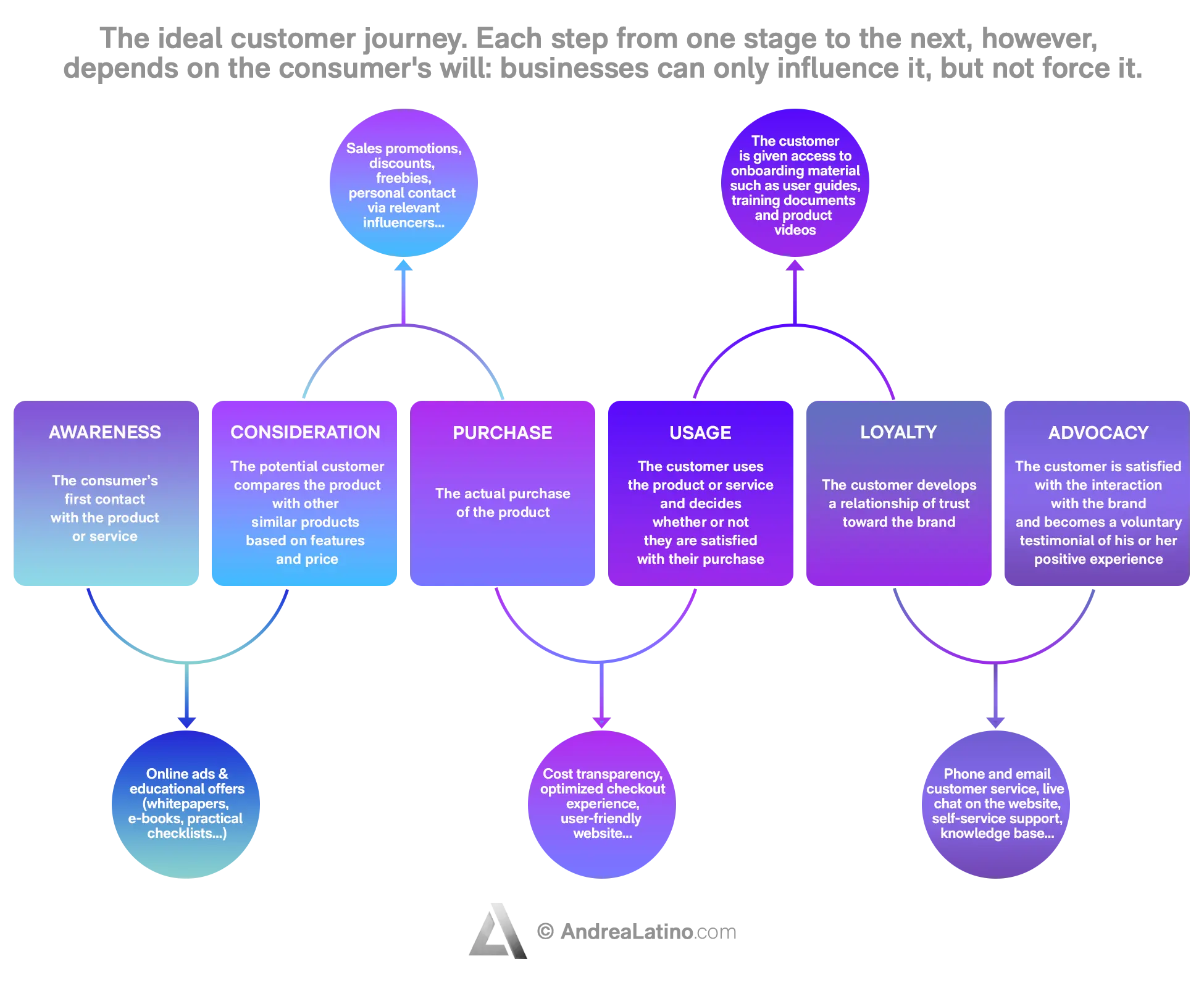
First of all, it is worth making one thing clear: customer journey is not a fixed and obligatory path. It is correct to try to map the customer journey, but users will always be free to move as they wish. Hence, customer journey is the most accurate approximation possible of the behavior we think the user will have.
A digital strategy, on the other hand, concerns all those measures we implement to try to get users to take certain actions and thus move them from one stage of the customer journey to another. This means that digital strategy is chosen by the company, but it only has the power to influence the consumer.
For example, if the user is in the “Consideration” stage, the company might try to move them to the next stage through a tactical activation with a 20 percent discount. If the user responds positively to this action, they will move on to “Purchase”. But if they don’t respond, at least the company has done its best.
Customer Journey Ideal Steps
Ideally, the journey originates from a consumer need and ends with the purchase of a good or service. The customer journey can be broken down into 6 important successive stages:
1. Awareness: The consumer’s first contact with the product or service.
2. Consideration: The potential customer compares the product with other similar products based on features and price.
3. Purchase: The actual purchase of the product.
4. Usage: The customer uses the product or service and decides whether or not they are satisfied with their purchase.
5. Loyalty: The customer develops a relationship of trust toward the brand.
6. Advocacy: The customer, satisfied with the interaction with the brand, becomes a voluntary testimonial of his or her positive experience.
Application fields
• Marketing: The customer journey is a marketing model that enables companies to understand and improve the overall consumer experience and perceived competitive advantage.
• Advertising: One of the touchpoints through which the potential consumer comes into contact with the product. A good advertising campaign becomes the gateway to a large number of trips.
• CRM (Customer Relationship Management). CRM strategies accompany the consumer journey to obtain information regarding potential customers’ preferences and consequently increase purchase frequency.



Do you have a Marketing & Sales challenge to tackle? Let’s face it. Together.
C-levels from these companies (AND MORE) relied on my expertise to overcome thEIR CHALLENGES IN THIS AREA. And You can, too.
Can I help you?

Industries
• Customer Journey in CRM software
All Apple users have an Apple ID, a profile that allows access to the various services offered by the brand. The account contains all personal information about the user: the music he or she listens to, the books he or she reads, the apps he or she downloads, and so on. For the company, it is a way to collect and keep up-to-date data on customers, offering them services in line with their preferences and needs.
• Customer Journey in marketing automation
Opsview is a software company that offers management and monitoring services for IT infrastructure. The original goal was to distinguish two types of leads (potential buyers): those who were already satisfied and those who might be interested in purchasing more content. Opsview resorted to marketing automation to classify leads from the “website” touchpoint by subjecting users to a questionnaire and scoring them according to their responses. Needless to say, this enabled the company to increase customers and consequently revenue.
Business Functions
• Customer Journey in support of website performance monitoring
Google Analytics is a free platform that allows you to monitor the performance of a website or application. It tracks and records web traffic by providing comprehensive statistics on the previous path of visitors and their interaction patterns. The platform then allows the characteristics of the site’s target “audience” to be drawn up based on customized metrics. The collected data can implement advertising, social and digital PR campaigns, as well as to measure the ROI (Return on Investment) of activated web marketing campaigns.
• Customer Journey in support of advertising
Another software that fits into the consumer’s path is Google Ads. It allows advertising space to be placed within Google’s search pages. The ads are displayed above or below the search results and are selected by an algorithm that monitors the keywords the user searches for. Google can then show advertisements relevant to the user’s search, generating traffic toward the page of the company that invested in the service.
• Customer journey in support of SEO Specialists
UberSuggest is a partly free tool that allows you to track the keywords that allow a website to rank among the top results in the Google SERP or other search engines. By identifying the main terms used, one can guess what information, products or services users are looking for on the web and attempt to rank among the top results.
Stay in wonderland
Let me show you how deep the rabbit hole goes.
Check out more of the Innovation Alphabet:

Gamification
Gamification
Gamification is actually adding a game-like element to make more fun and engaging something that’s not necessarily a game. It’s all about turning a task that might be boring or difficult into a more enjoyable and motivating activity. You can also earn points, badges, and rewards for completing certain actions or challenges. Are you ready to play?
Dive In
Business Intelligence
Business Intelligence
A smart business means efficiency: Business Intelligence represents the ability to collect up-to-date data, present it in easy-to-understand formats, and deliver it in a timely manner to employees. Making data-driven decision-making and management processes leads to competitive advantage, reduces inefficiencies, and improves productivity and service at all levels.
Dive In
Artificial Scarcity
Artificial Scarcity
We often tend to desire what we cannot have. Or what we are in danger of losing: Artificial Scarcity is a strategy that flaunts a limited number of items that do not correspond to actual availability. The goal is to stimulate the perception in consumers that the stock of items is about to run out and thus create a need based on the “fear of being cut off” or the intention to buy the item in order to resell it at a higher price.
Dive In
Subscription Model
Subscription Model
A subscription model is a business tool that generates revenue by charging customers a fee at regular intervals. The company provides products or services to subscribers on a subscription basis, usually monthly or annually. In this way, loyalty has become more important than acquiring new users.
Dive In
Holacracy & Flat Organization
Holacracy & Flat Organization
A “flat organization” breaks down the traditional hierarchy and removes its negative connotation, while “holacracy” is the business tool that facilitates its formation. Flat organizations place more emphasis on communication and collaboration, aspiring to a distributed decision-making process that gives each employee a voice. But this is a model that is difficult to implement.
Dive In
Mass Customization
Mass Customization
Mass customization is an initiative adopted by companies to embrace the increasingly diversified needs of customers. By offering customizable products and services, consumers feel engaged and can bring their creativity into play. Brands gain from this a boost in perceived value and the opportunity to fuel a positive word-of-mouth marketing.
Dive In
Coopetition
Coopetition
If you can’t beat them, join them. Coopetition is a business strategy that defines cooperative and competitive relationships between competing companies in the same young or high-growth market. The goal is to travel a stretch of road together to lower initial research and development costs. Once the desired results are achieved, the companies will return to being enemies as before.
Dive In
MVP
MVP
To the disappointment of all sports fans, this is not an article about Michael Jordan. In the language of business, MVP stands for Minimum Viable Product and indicates the version of a new product that has enough features to attract customers. In this way, a team can gather the most feedback with the least effort, improve the prototype, and validate its sale.
Dive In
Agile
Agile
Agile is an approach to software development designed to respond to change. Teams quickly analyze the context in which they operate, identify uncertainties faced, and figure out how to adapt to always move forward. Interaction between individuals comes before processes and tools; collaboration with the customer is more important than negotiating contracts.
Dive In
Bounded Rationality
Bounded Rationality
The best solutions always come to mind when it is too late. This is because human beings tend to make decisions on the basis of satisfaction rather than optimization. Bounded Rationality means that we are unable to think clearly and linearly, we proceed by trial and error and forget all the possible variables that affect the process. But we are also flawed.
Dive In