Innovation Alphabet
Artificial Scarcity
In a nutshell
We often tend to desire what we cannot have, or what we are in danger of losing: Artificial Scarcity is a strategy that flaunts a limited number of items that do not correspond to actual availability. The goal is to stimulate the perception in consumers that the stock of items is about to run out and thus create a need based on the “fear of being cut off”, or the intention to buy the item in order to resell it at a higher price.

Application Fields
• Marketing: The scarcity effect shifts the attention of potential customers from the actual need for a product and the loss of money resulting from the purchase to the possible loss of the product itself. “Limited offer” or “Only 2 remaining” banners act as accelerators in the buyer’s decision-making process.
• Sales: The organization of ad hoc days dedicated to special discounts (Black Friday, Cyber Monday, etc.) catalyzes the attention of users, who will deem the occasion as unrepeatable and will do everything to grab the products on sale during a limited specific period. This can be a godsend for sellers.
• Perceived Value: Artificial scarcity is an ancient technique, with one of the most frequent applications being diamonds, which have always been considered a rare object found only in certain places in the world because of intense mining. In reality, diamonds are much more common than people think. In 1880, Cecil Rhodes, president of the De Beers mining company, realized that he could inflate prices on command if he took control of the rights over every mine. The practice has continued ever since.
Industries
• Artificial Scarcity in the retail industry
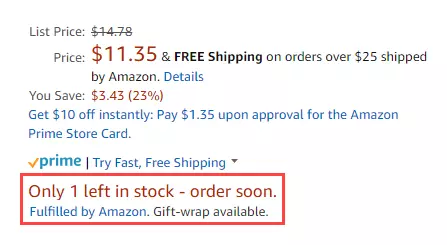
One of the classic examples of artificial scarcity is the “Only 1 left in stock” notice. This is a particularly common technique on e-commerce sites, primarily Amazon. They present an item as particularly in demand, which makes it more desirable. It is a mechanism that triggers a sale and pushes back against indecisive and procrastinating buyers.
• Artificial Scarcity in the FMCG industry
Starbucks cleverly uses the limited-edition technique for the exclusive launch of certain beverages or foods, often during the holidays. One example is the Pumpkin Spiced Latte, an iconic concoction served in cups decorated with a Halloween theme. The truth is that each drink and each cup could be produced all year long, but it is then likely that the same flood of customers would not be generated.
• Artificial Scarcity in social media
In 2016, the social network Snapchat, popular with Generation Z, introduced Spectacles: special glasses that record videos of a few seconds from the wearer’s point of view. But no online store offered them for sale, as is the usual good practice. Snap Inc. came up with the idea of making them available for one day only via Snapbots dropped into random cities out of nowhere. The news, of course, spread within minutes, and users immediately lined up hoping they would not run out of stock.


Do you have a Marketing & Sales challenge to tackle? Let’s face it. Together.
C-levels from these companies (AND MORE) relied on my expertise to overcome thEIR CHALLENGES IN THIS AREA. and You can, too.
Can I help you?
Business Functions
• Artificial Scarcity in support of marketing
OnePlus is a Chinese smartphone company. It entered the market in 2013, and to give an exclusive aura to the products it offered, it initially decided to sell them only to those who possessed an invitation. A marketing strategy that drove enormous curiosity about the phone, generating hype in those “excluded” from buying.
• Artificial Scarcity in support of sales
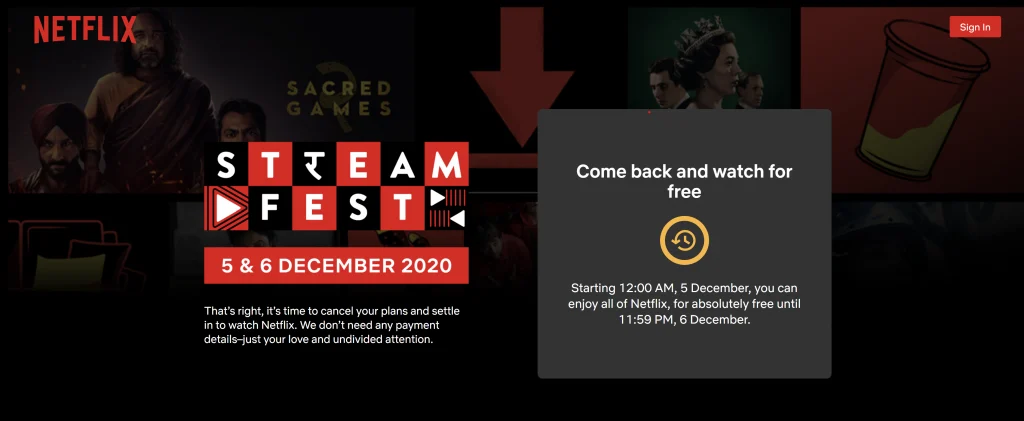
In 2020, Netflix made its streaming platform free for two days, December 5 and 6. The event was called “StreamFest” and huge amounts of access were recorded. Did you notice anything strange? Throughout the year Netflix offers the 30-day free trial, 15 times as much. Yet, the strategy was able to gather potential new users in a small period, broadening their base by presenting the opportunity as unrepeatable.
• Artificial Scarcity in support of new product realization
Supreme is a New York-based brand that makes skateboards and casual clothing at exorbitant prices. The products, however, partly because they are worn by many celebrities, are so popular that they are often resold at 20 times the original price. Supreme thus decided to gradually make more and more original, curious, and above all, limited products, even to the point of making a brick with the brand’s logo, which still sold out within minutes.
Stay in wonderland
Let me show you how deep the rabbit hole goes.
Check out more of the Innovation Alphabet:

Gamification
Gamification
Gamification is actually adding a game-like element to make more fun and engaging something that’s not necessarily a game. It’s all about turning a task that might be boring or difficult into a more enjoyable and motivating activity. You can also earn points, badges, and rewards for completing certain actions or challenges. Are you ready to play?
Dive In
Business Intelligence
Business Intelligence
A smart business means efficiency: Business Intelligence represents the ability to collect up-to-date data, present it in easy-to-understand formats, and deliver it in a timely manner to employees. Making data-driven decision-making and management processes leads to competitive advantage, reduces inefficiencies, and improves productivity and service at all levels.
Dive In
Artificial Scarcity
Artificial Scarcity
We often tend to desire what we cannot have. Or what we are in danger of losing: Artificial Scarcity is a strategy that flaunts a limited number of items that do not correspond to actual availability. The goal is to stimulate the perception in consumers that the stock of items is about to run out and thus create a need based on the “fear of being cut off” or the intention to buy the item in order to resell it at a higher price.
Dive In
Subscription Model
Subscription Model
A subscription model is a business tool that generates revenue by charging customers a fee at regular intervals. The company provides products or services to subscribers on a subscription basis, usually monthly or annually. In this way, loyalty has become more important than acquiring new users.
Dive In
Holacracy & Flat Organization
Holacracy & Flat Organization
A “flat organization” breaks down the traditional hierarchy and removes its negative connotation, while “holacracy” is the business tool that facilitates its formation. Flat organizations place more emphasis on communication and collaboration, aspiring to a distributed decision-making process that gives each employee a voice. But this is a model that is difficult to implement.
Dive In
Mass Customization
Mass Customization
Mass customization is an initiative adopted by companies to embrace the increasingly diversified needs of customers. By offering customizable products and services, consumers feel engaged and can bring their creativity into play. Brands gain from this a boost in perceived value and the opportunity to fuel a positive word-of-mouth marketing.
Dive In
Coopetition
Coopetition
If you can’t beat them, join them. Coopetition is a business strategy that defines cooperative and competitive relationships between competing companies in the same young or high-growth market. The goal is to travel a stretch of road together to lower initial research and development costs. Once the desired results are achieved, the companies will return to being enemies as before.
Dive In
MVP
MVP
To the disappointment of all sports fans, this is not an article about Michael Jordan. In the language of business, MVP stands for Minimum Viable Product and indicates the version of a new product that has enough features to attract customers. In this way, a team can gather the most feedback with the least effort, improve the prototype, and validate its sale.
Dive In
Agile
Agile
Agile is an approach to software development designed to respond to change. Teams quickly analyze the context in which they operate, identify uncertainties faced, and figure out how to adapt to always move forward. Interaction between individuals comes before processes and tools; collaboration with the customer is more important than negotiating contracts.
Dive In
Bounded Rationality
Bounded Rationality
The best solutions always come to mind when it is too late. This is because human beings tend to make decisions on the basis of satisfaction rather than optimization. Bounded Rationality means that we are unable to think clearly and linearly, we proceed by trial and error and forget all the possible variables that affect the process. But we are also flawed.
Dive In