Innovation Alphabet
Business Intelligence
in a nutshell
A smart business means efficiency: Business Intelligence represents the ability to collect up-to-date data, present it in easy-to-understand formats, and deliver it in a timely manner to employees. Executing data-driven management decisions and processes leads to competitive advantages, reduces inefficiencies, and improves productivity and services at every level.

Application Fields
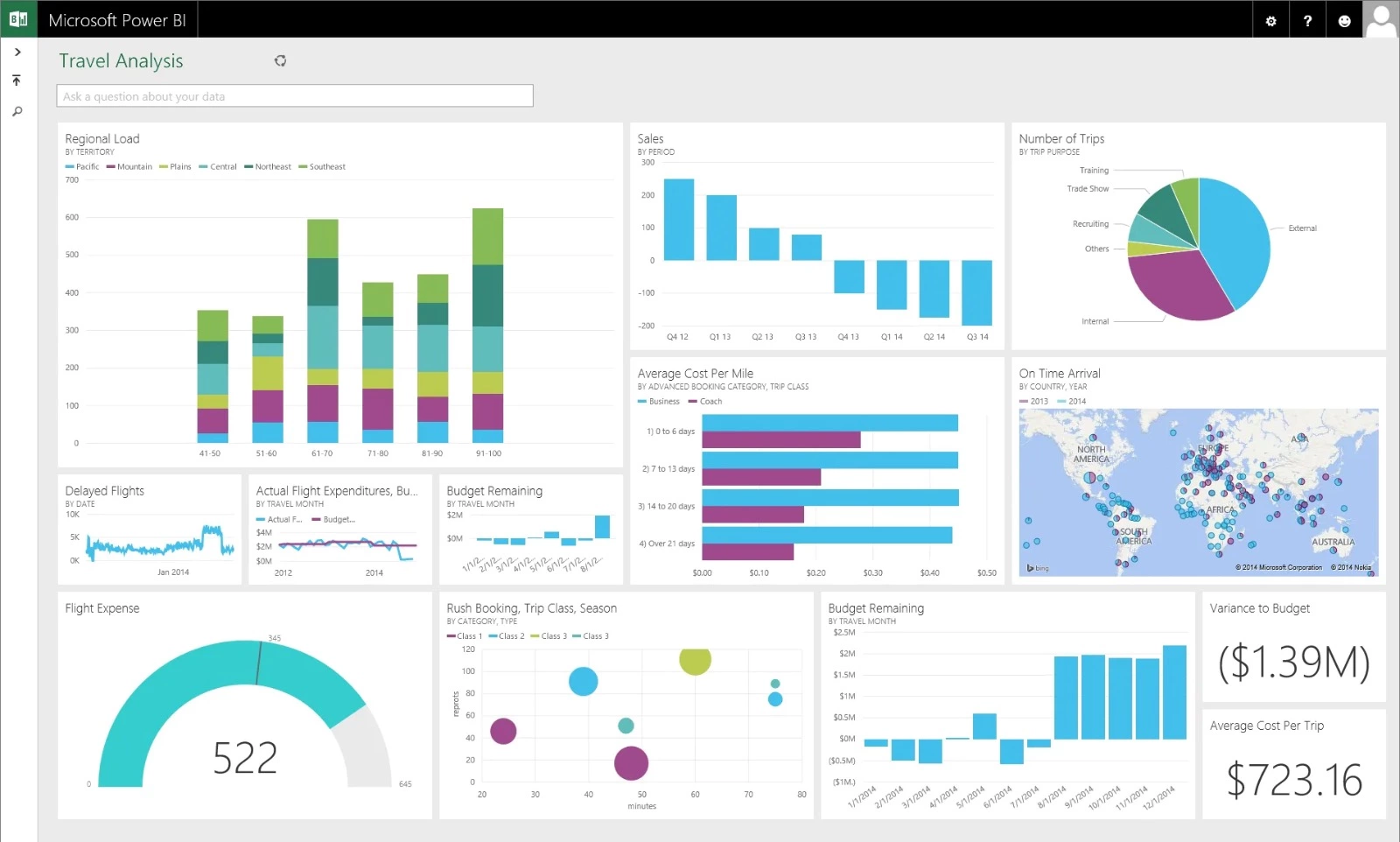
• Data visualization: The graphical representation of data utilizing visual elements such as diagrams, charts, and maps to make information and trends more understandable. In a business where everything relies on data, visualization tools are critical for analyzing large amounts of information and making effective, objective decisions.
• Data mining: This is a process in which relevant and accurate information is extracted from a very large amount of data through automated or semi-automated methods. Data mining enables the discovery of active trends both in specific industries and the company as a whole.
| Feature | Data Mining | Business Intelligence |
|---|---|---|
| Purpose | Exploring and formatting data to find answers to business problems | Interpreting and presenting data to stakeholders to inform data-driven decisions |
| Focus | Identifying new KPIs | Demonstrating KPI progress |
| Volume | Processing small and specific datasets for targeted analysis | Processing relational databases to track enterprise-level metrics |
| Results | Unique datasets in a usable format | Dashboards, graphs, charts, reports |
• Competitor analysis: Taking a scientific and numerical approach can also be useful in analyzing competition in the same market sector to understand the choices, strategies, and actions of key rivals. The data collected on competitors can be utilized for one’s own marketing plan.
Industries
• Business Intelligence in the Retail Industry
Lotte Corporation is a South Korean multinational company operating in the retail sector. By implementing Business Intelligence tools, it has experienced an increase in consumer loyalty levels and a $10 million increase in sales. This started with identifying the reasons that led to shopping cart abandonment and other previously unresolved issues.
• Business Intelligence in the Construction Industry
Colombian building materials manufacturer Grupo Argos made the decision to transform itself into a smart business in order to leverage data and improve performance. Using big data, it gained a more lucid and in-depth view of customer behavior, increased standardization and automation, and reduced time and costs. The result was a competitive advantage in the cement market.
• Business Intelligence in the Aviation Industry
Sabre Airline Solutions, founded in Texas in 2000, provides Software-as-a-Service (SaaS) solutions for the aviation industry. Since this is an industry that travels – literally – at high speed, it has become essential to possess data regarding consumer habits in real time. Additionally, there is critical information to be managed such as passenger reservations, revenue issues, flight management, network, and crews. Sabre is remedying this by using Business Intelligence tools.



Do you have a Strategy & Innovation challenge to tackle? Let’s face it. Together.
C-levels from these companies (AND MORE) relied on my expertise to overcome thEIR CHALLENGES IN THIS AREA. and You can, too.
Can I help you?

Business functions
• Business Intelligence in support of shipping services
New York Shipping Exchange is a company that leverages technology with the goal of improving the process of shipping overseas, especially with remote locations. Before utilizing Business Intelligence, processing and data entry were completed manually. By automating these processes, the company tripled the volume of shipments between Asia and the United States in 2019.
• Business Intelligence in support of communication
Stitch Fix is a California fashion company that offers products according to customer preferences, collected first through a survey followed by purchase data. Business Intelligence was selected in order to decrease the number of returns. Through deeper customer profiling, the company has significantly reduced returns and reached a customer base of 3.4 million shoppers in 2020.
• Business Intelligence in support of the Customer Experience
Expedia Group is an American online travel company dedicated to individual and small/medium business customers. Its goal was to offer an online experience as good as the quality offered by offline organizations. By choosing a Business Intelligence strategy, they gained access to real-time Key Performance Indicators and cross-departmental communication.
Stay in wonderland
Let me show you how deep the rabbit hole goes.
Check out more of the Innovation Alphabet:

Gamification
Gamification
Gamification is actually adding a game-like element to make more fun and engaging something that’s not necessarily a game. It’s all about turning a task that might be boring or difficult into a more enjoyable and motivating activity. You can also earn points, badges, and rewards for completing certain actions or challenges. Are you ready to play?
Dive In
Business Intelligence
Business Intelligence
A smart business means efficiency: Business Intelligence represents the ability to collect up-to-date data, present it in easy-to-understand formats, and deliver it in a timely manner to employees. Making data-driven decision-making and management processes leads to competitive advantage, reduces inefficiencies, and improves productivity and service at all levels.
Dive In
Artificial Scarcity
Artificial Scarcity
We often tend to desire what we cannot have. Or what we are in danger of losing: Artificial Scarcity is a strategy that flaunts a limited number of items that do not correspond to actual availability. The goal is to stimulate the perception in consumers that the stock of items is about to run out and thus create a need based on the “fear of being cut off” or the intention to buy the item in order to resell it at a higher price.
Dive In
Subscription Model
Subscription Model
A subscription model is a business tool that generates revenue by charging customers a fee at regular intervals. The company provides products or services to subscribers on a subscription basis, usually monthly or annually. In this way, loyalty has become more important than acquiring new users.
Dive In
Holacracy & Flat Organization
Holacracy & Flat Organization
A “flat organization” breaks down the traditional hierarchy and removes its negative connotation, while “holacracy” is the business tool that facilitates its formation. Flat organizations place more emphasis on communication and collaboration, aspiring to a distributed decision-making process that gives each employee a voice. But this is a model that is difficult to implement.
Dive In
Mass Customization
Mass Customization
Mass customization is an initiative adopted by companies to embrace the increasingly diversified needs of customers. By offering customizable products and services, consumers feel engaged and can bring their creativity into play. Brands gain from this a boost in perceived value and the opportunity to fuel a positive word-of-mouth marketing.
Dive In
Coopetition
Coopetition
If you can’t beat them, join them. Coopetition is a business strategy that defines cooperative and competitive relationships between competing companies in the same young or high-growth market. The goal is to travel a stretch of road together to lower initial research and development costs. Once the desired results are achieved, the companies will return to being enemies as before.
Dive In
MVP
MVP
To the disappointment of all sports fans, this is not an article about Michael Jordan. In the language of business, MVP stands for Minimum Viable Product and indicates the version of a new product that has enough features to attract customers. In this way, a team can gather the most feedback with the least effort, improve the prototype, and validate its sale.
Dive In
Agile
Agile
Agile is an approach to software development designed to respond to change. Teams quickly analyze the context in which they operate, identify uncertainties faced, and figure out how to adapt to always move forward. Interaction between individuals comes before processes and tools; collaboration with the customer is more important than negotiating contracts.
Dive In
Bounded Rationality
Bounded Rationality
The best solutions always come to mind when it is too late. This is because human beings tend to make decisions on the basis of satisfaction rather than optimization. Bounded Rationality means that we are unable to think clearly and linearly, we proceed by trial and error and forget all the possible variables that affect the process. But we are also flawed.
Dive In