Innovation Alphabet
Design Thinking
in a nutshell
Design Thinking is a methodology that can increase the chances of a company making effective decisions using creative problem solving. It is a process that allows through predefined, collaborative steps to carry out work on products and services.

Steps
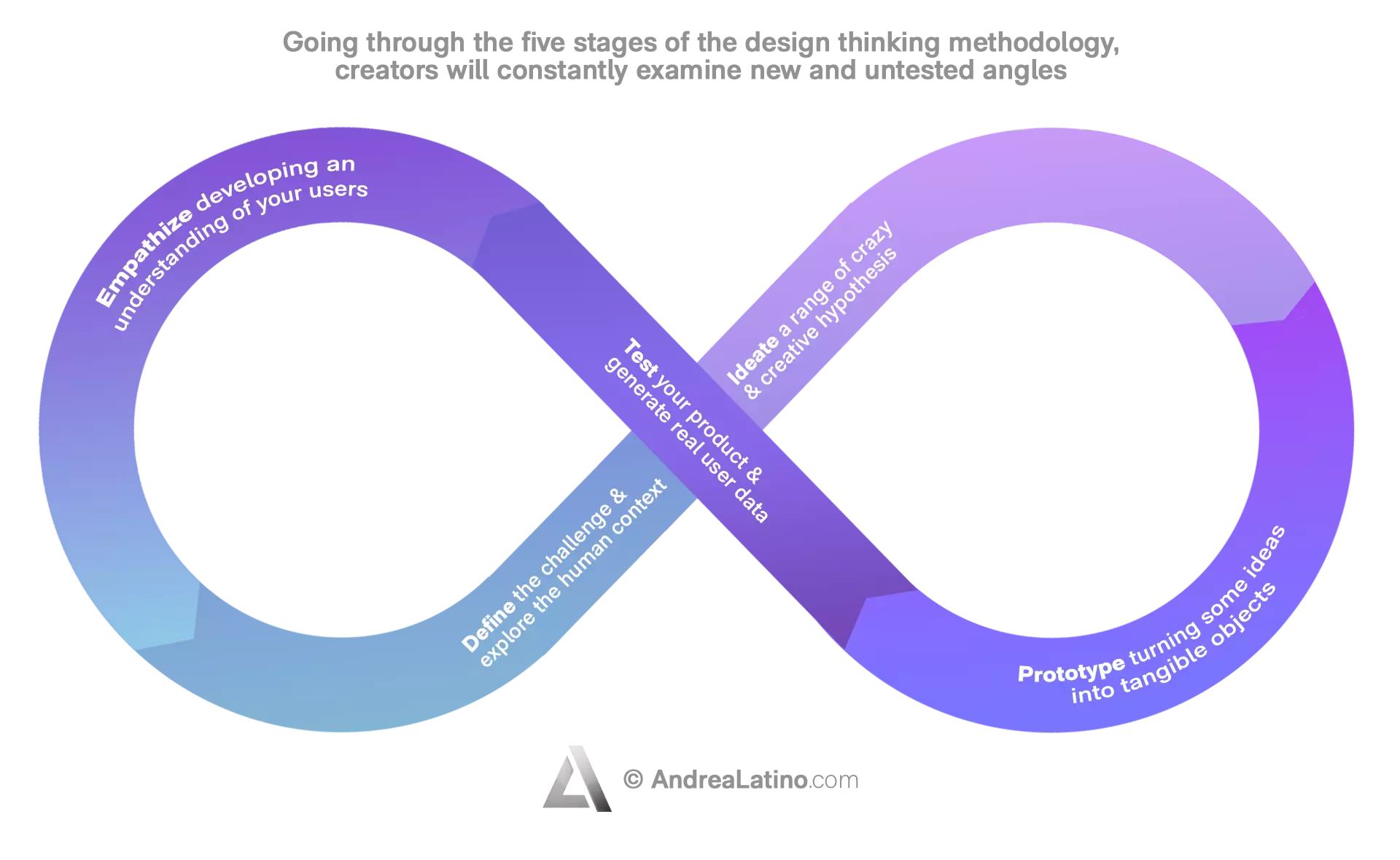
Problem solving with the “human-centered” process goes through 5 stages:
Empathize: Put yourself in the customer’s shoes and understand their needs to fully comprehend the problem that needs to be solved.
Define: Analyze the information gathered to define and circumscribe the problem.
Ideate: Design a solution by unleashing the team’s creativity and recording the ideas that emerge.
Prototype: Turn ideas into prototypes to understand what might or might not work.
Test: Experiment with the chosen solution to receive feedback. The response will confirm the work done or refute it and allow the team to start again.
Application Fields
• Startup development: Startups apply the Design Thinking approach together with the Lean Startup method, which is the radical way of designing and launching an innovative enterprise. The combination of the two methodologies forms the Design Sprint, which is the main reference point regarding the action practices of startup companies.
• Product and service design: Design Thinking also concerns Sprint Execution, processes and structures for the realization and delivery of products and services made according to user needs.
• Training: The method is then handed down in staff training to teach how to creatively solve complex problems by creating a culture of innovation and fostering a cohesive and proactive environment.
Industries
• Design Thinking in the pharmaceutical industry
Mayo Clinic, a leading U.S. nonprofit organization specializing in medical practice and research, used the Design Thinking approach to create SPARC (See, Plan, Act, Refine, Communicate). This is an innovation program that uses Design Thinking principles to implement healthcare. For example, industrial engineers observe the interaction between doctors and patients and then try to give birth to ideas that will help improve efficiency.
• Design Thinking in the energy industry
Innogy, a German energy company, resorted to creative thinking to solve the problem of insufficient sales of electric cars. The team involved identified the solution as a lack of sufficient charging stations. Once the problem was defined, Innogy quickly devised an ingenious remedy, proposing the rental of e-cars through online booking.
• Design Thinking in the service industry
The U.S. company Airbnb, which specializes in short-term vacation rentals, leveraged human-centered design to revolutionize its business strategy. Design Thinking enabled the creative team to understand the real “product”: not the website or the app, but the trip. The key to achieve such a solution – and becoming, probably, the most important “interpersonal” marketplace in existence – was giving employees problems to solve instead of to-do lists.


Do you have a Operations & Human Resources challenge to tackle? Let’s face it. Together.
C-levels from these companies (AND MORE) relied on my expertise to overcome thEIR CHALLENGES IN THIS AREA. And you can, too.
Can I help you?
Business Functions
• Design Thinking in support of marketing
Domino’s Pizza, an international catering company specialized in selling pizza, has implemented its marketing activities through the Design Thinking approach. Smart Track My Pizza is a tool which allows the customer to track the preparation of the order minute by minute. It is an idea that has helped to greatly increase the number of customers for the chain, which has now come to prepare more than one million pizzas every day. In the United States, one out of every eight pizzas is sold by Domino’s. Luckily, in Italy, a lot less.
• Design Thinking in support of HR
Google wanted to embed within its corporate structure a mindset based on the involvement of corporate employees. The goal? To create and nurture an organizational culture suitable for conveying confidence and a proactive attitude toward innovative processes. To implement such a project, the company adopted the famous 80/20 formula, whereby employees are encouraged to spend 80 percent of their time on key projects and 20 percent on innovation activities pertaining to their personal interests.
• Design Thinking in support of management
Uber is a company specializing in private car transportation service that uses a mobile application to connect passengers and drivers directly. It has adopted the creative thinking approach to make management more functional. With the help of Design Thinking, Uber has been able to adopt and manage new technologies that enable it to solve complex logistical challenges, thus succeeding in expanding worldwide and expanding services for society.
Stay in wonderland
Let me show you how deep the rabbit hole goes.
Check out more of the Innovation Alphabet:

Gamification
Gamification
Gamification is actually adding a game-like element to make more fun and engaging something that’s not necessarily a game. It’s all about turning a task that might be boring or difficult into a more enjoyable and motivating activity. You can also earn points, badges, and rewards for completing certain actions or challenges. Are you ready to play?
Dive In
Business Intelligence
Business Intelligence
A smart business means efficiency: Business Intelligence represents the ability to collect up-to-date data, present it in easy-to-understand formats, and deliver it in a timely manner to employees. Making data-driven decision-making and management processes leads to competitive advantage, reduces inefficiencies, and improves productivity and service at all levels.
Dive In
Artificial Scarcity
Artificial Scarcity
We often tend to desire what we cannot have. Or what we are in danger of losing: Artificial Scarcity is a strategy that flaunts a limited number of items that do not correspond to actual availability. The goal is to stimulate the perception in consumers that the stock of items is about to run out and thus create a need based on the “fear of being cut off” or the intention to buy the item in order to resell it at a higher price.
Dive In
Subscription Model
Subscription Model
A subscription model is a business tool that generates revenue by charging customers a fee at regular intervals. The company provides products or services to subscribers on a subscription basis, usually monthly or annually. In this way, loyalty has become more important than acquiring new users.
Dive In
Holacracy & Flat Organization
Holacracy & Flat Organization
A “flat organization” breaks down the traditional hierarchy and removes its negative connotation, while “holacracy” is the business tool that facilitates its formation. Flat organizations place more emphasis on communication and collaboration, aspiring to a distributed decision-making process that gives each employee a voice. But this is a model that is difficult to implement.
Dive In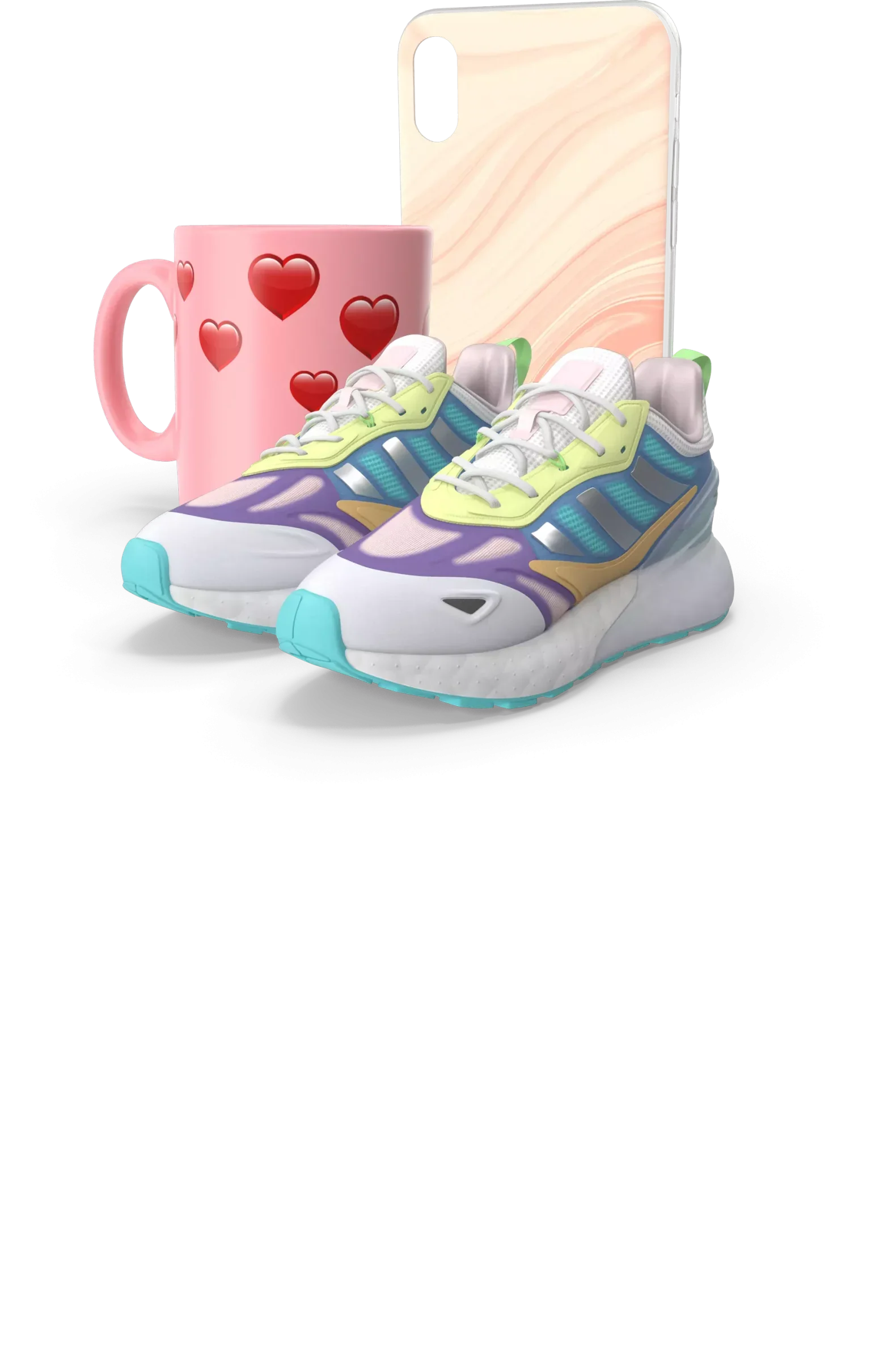
Mass Customization
Mass Customization
Mass customization is an initiative adopted by companies to embrace the increasingly diversified needs of customers. By offering customizable products and services, consumers feel engaged and can bring their creativity into play. Brands gain from this a boost in perceived value and the opportunity to fuel a positive word-of-mouth marketing.
Dive In
Coopetition
Coopetition
If you can’t beat them, join them. Coopetition is a business strategy that defines cooperative and competitive relationships between competing companies in the same young or high-growth market. The goal is to travel a stretch of road together to lower initial research and development costs. Once the desired results are achieved, the companies will return to being enemies as before.
Dive In
MVP
MVP
To the disappointment of all sports fans, this is not an article about Michael Jordan. In the language of business, MVP stands for Minimum Viable Product and indicates the version of a new product that has enough features to attract customers. In this way, a team can gather the most feedback with the least effort, improve the prototype, and validate its sale.
Dive In
Agile
Agile
Agile is an approach to software development designed to respond to change. Teams quickly analyze the context in which they operate, identify uncertainties faced, and figure out how to adapt to always move forward. Interaction between individuals comes before processes and tools; collaboration with the customer is more important than negotiating contracts.
Dive In
Bounded Rationality
Bounded Rationality
The best solutions always come to mind when it is too late. This is because human beings tend to make decisions on the basis of satisfaction rather than optimization. Bounded Rationality means that we are unable to think clearly and linearly, we proceed by trial and error and forget all the possible variables that affect the process. But we are also flawed.
Dive In