Innovation Alphabet
Advanced Analytics
In a nutshell
The term “Advanced Analytics” refers to the ability to autonomously or semi-autonomously analyze data and content to identify correlations, develop analyses, predictions, and recommendations. It is not just a matter of collecting information and then organizing it into watertight compartments: the ultimate goal is to identify a dialogue pattern from a data-driven perspective.

Application Fields
• Sports activity: Most smartphones support apps that monitor physical activity, but the study of big data promises to improve even performance. Through advanced analytics solutions, it is possible to prevent overexertion and injuries, set up hyper-personalized training sessions and thus enrich the sports experience.
• Digital Marketing: As easily predictable, in digital marketing big data assume an indispensable role. For example, they “anticipate” customer needs. A huge amount of information is collected from a huge amount of sources (business systems, e-commerce portals, social media…). This way, advertisers and merchants can initiate promotional campaigns and sales strategies customized to each type of buyer.
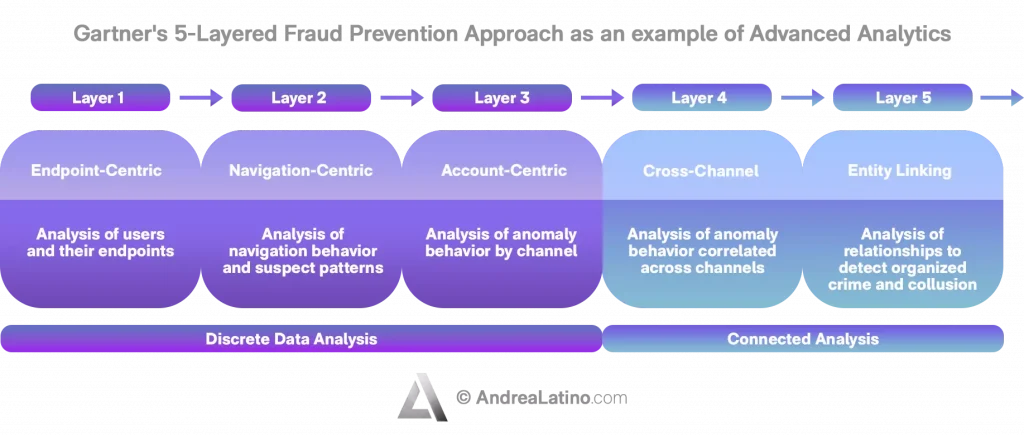
• Banking Industry: Advanced analytics tools can be used in loan and mortgage origination to optimize fraud prevention. Through credit ratings, banks can accelerate the customer assessment process. This confirms the viability of a loan or identifies profiles that, due to credit history and financial behavior, represent a higher risk. Gartner broke down fraud prevention into five layers:
Industries
• Advanced Analytics in the healthcare industry
Four of the hospitals that make up the Assistance Publique-H’pitaux de Paris (AP-HP) have adopted an Advanced Analytics system. Through machine learning and big data solutions, it aspires to predict the rate of hospitalization 15 days in advance. In the event of a spike in visits and admissions, hospitals would employ more staff to reduce waiting times and better manage patients. Losses could thus be reduced, and health insurance would gain in efficiency.
• Advanced Analytics in the energy industry
Shell, a major global player in the oil and natural gas industry, is using data to drive its own organizational change. For example, working with Microsoft, the company has designed a collaborative digital platform through which it can monitor not only its own sustainability initiatives, but also those of its suppliers. Shell’s long-term goal is not to drive digital transformation, but energy transformation. Thanks to Advanced Analytics, the company is going to evolve the industry toward sustainable energy solutions.
• Advanced Analytics in the service industry
The Amsterdam Fire Department has used some Advanced Analytics techniques to identify the highest fire risk areas in the city, and improve, as a result, the performance of the city’s fire protection service. How? By combining the government’s open-source data on buildings, roads, waterways and means of transportation with fire department incident reports through sensors placed inside fire hoses and firefighters’ personal protection equipment. This has enabled the service to identify 12 million possible accidents.



Do you have a Marketing & Sales challenge to tackle? Let’s face it. Together.
C-levels from these companies (AND MORE) relied on my expertise to overcome thEIR CHALLENGES IN THIS AREA. And you can, too.
Can I help you?

Business Functions
• Advanced Analytics in support of marketing
Walmart Stores, the world’s largest retail chain, has created an analytics center to monitor the ROI (Return on Investments) of its marketing campaigns: the Data Café. Data Café enables the rapid modeling, manipulation, and visualization of huge volumes of data. The system provides automatic alerts: if certain metrics fall below set thresholds, the pertinent team is alerted so that the reasons are understood. The Data Café collects information from 200 sources (weather, social media, gas prices, etc.): any detail could be the key to solve a problem.
• Advanced Analytics in support of HR
For a long time, Bank of America Corporation experienced some difficulties in keeping its employees responsible for the call center. By using the power of Big Data the company realized that the reason for layoffs was related to inter-office collaboration. Specifically, individual employees’ breaks did not coincide with anyone else’s except during lunch: a scant 15 minutes during which 80 percent of interactions occurred. Interpreting the information gathered, the bank allowed teams of employees to spend their breaks together, unifying their schedules. After a few weeks, call handling time was 23% faster and cohesion had increased by 18%. Translated: $15 million more for the company.
• Advanced Analytics in support of management
Metalco, a leading manufacturer of street furniture and dehors, has invested in Advanced Analytics systems to improve demand forecasting in the supply chain. Predictive models capable of creating advanced and automated analytics. These are useful for the company’s managers to obtain information in order to optimize production capacity and thus produce the right quantity of required items. By studying and interpreting the data, demand forecasting has improved by 20 percent.
Stay in wonderland
Let me show you how deep the rabbit hole goes.
Check out more of the Innovation Alphabet:

Gamification
Gamification
Gamification is actually adding a game-like element to make more fun and engaging something that’s not necessarily a game. It’s all about turning a task that might be boring or difficult into a more enjoyable and motivating activity. You can also earn points, badges, and rewards for completing certain actions or challenges. Are you ready to play?
Dive In
Business Intelligence
Business Intelligence
A smart business means efficiency: Business Intelligence represents the ability to collect up-to-date data, present it in easy-to-understand formats, and deliver it in a timely manner to employees. Making data-driven decision-making and management processes leads to competitive advantage, reduces inefficiencies, and improves productivity and service at all levels.
Dive In
Artificial Scarcity
Artificial Scarcity
We often tend to desire what we cannot have. Or what we are in danger of losing: Artificial Scarcity is a strategy that flaunts a limited number of items that do not correspond to actual availability. The goal is to stimulate the perception in consumers that the stock of items is about to run out and thus create a need based on the “fear of being cut off” or the intention to buy the item in order to resell it at a higher price.
Dive In
Subscription Model
Subscription Model
A subscription model is a business tool that generates revenue by charging customers a fee at regular intervals. The company provides products or services to subscribers on a subscription basis, usually monthly or annually. In this way, loyalty has become more important than acquiring new users.
Dive In
Holacracy & Flat Organization
Holacracy & Flat Organization
A “flat organization” breaks down the traditional hierarchy and removes its negative connotation, while “holacracy” is the business tool that facilitates its formation. Flat organizations place more emphasis on communication and collaboration, aspiring to a distributed decision-making process that gives each employee a voice. But this is a model that is difficult to implement.
Dive In
Mass Customization
Mass Customization
Mass customization is an initiative adopted by companies to embrace the increasingly diversified needs of customers. By offering customizable products and services, consumers feel engaged and can bring their creativity into play. Brands gain from this a boost in perceived value and the opportunity to fuel a positive word-of-mouth marketing.
Dive In
Coopetition
Coopetition
If you can’t beat them, join them. Coopetition is a business strategy that defines cooperative and competitive relationships between competing companies in the same young or high-growth market. The goal is to travel a stretch of road together to lower initial research and development costs. Once the desired results are achieved, the companies will return to being enemies as before.
Dive In
MVP
MVP
To the disappointment of all sports fans, this is not an article about Michael Jordan. In the language of business, MVP stands for Minimum Viable Product and indicates the version of a new product that has enough features to attract customers. In this way, a team can gather the most feedback with the least effort, improve the prototype, and validate its sale.
Dive In
Agile
Agile
Agile is an approach to software development designed to respond to change. Teams quickly analyze the context in which they operate, identify uncertainties faced, and figure out how to adapt to always move forward. Interaction between individuals comes before processes and tools; collaboration with the customer is more important than negotiating contracts.
Dive In
Bounded Rationality
Bounded Rationality
The best solutions always come to mind when it is too late. This is because human beings tend to make decisions on the basis of satisfaction rather than optimization. Bounded Rationality means that we are unable to think clearly and linearly, we proceed by trial and error and forget all the possible variables that affect the process. But we are also flawed.
Dive In