Innovation alphabet
Digital Core
in a nutshell
Digital Core is the technological brain of the company: it concerns the digitalization processes that enables efficient and low-cost internal operations, improving the operating margin. Today, it is no longer enough to “do digital” but to “be digital.” Having a Digital Core that can cope with advances in technology can, in fact, result in a competitive advantage.

Application Fields
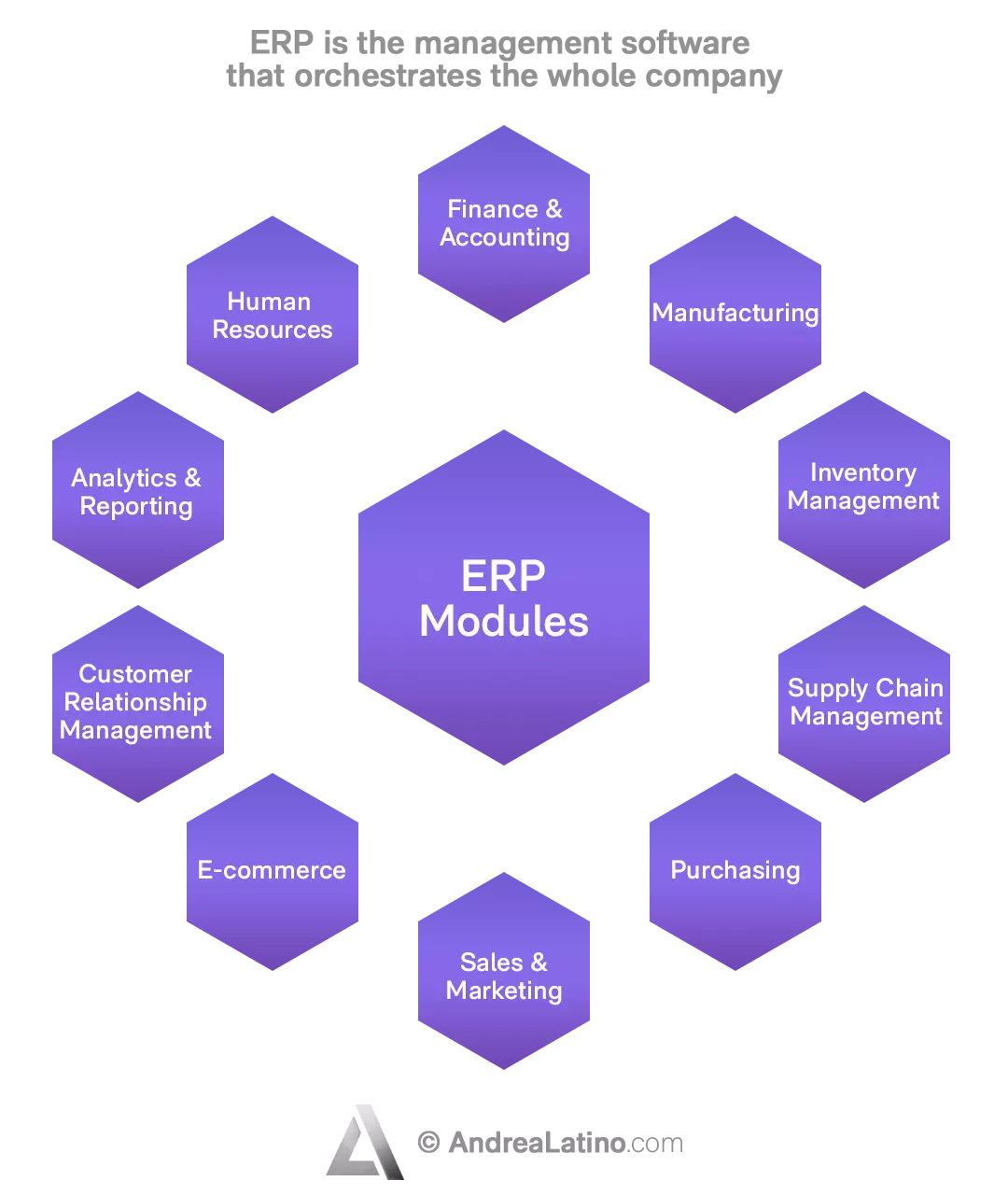
• Facilitate Smart Working: With Cloud ERP Software, the data and applications needed by a business team are always readily available. This allows for seamless coordination among team members regardless of location.
• Sales enhancement: Integration between CRM and ERP allows the sales department to bring together data from each business department. In this way, they have a database containing all synchronized information. Sales managers can thus formulate advantageous offers, prevent any complaints, and provide customers with precise delivery times.
• Logistics improvement: The logistics department within a company that adopts a Digital Core system is able to optimize inventory control by bringing together order, sales, and delivery data in one centralized software. A situation that helps management to make predictions regarding future orders, to plan medium to long term decisions, to make timely decisions that can speed up the handling of an order, and to avoid stockouts of goods or raw materials.
Industries
• Digital Core in the pharmaceutical industry
Comar, a medium-sized company specializing in the production of medical and pharmaceutical components, adopted the Digital Core (ERP) system. By doing so, it was able to rely on more information related to product traceability and processing in real time, so as to be able to efficiently complete necessary audits. This was a key step. In fact, it enabled them to meet production demands on short notice, maintain high quality, and meet deadlines. By applying a Digital Core system, Comar has been able to outperform the competition and become the company driving innovation in its target market.
• Digital Core in the energy industry
Bluewater Power Distribution Corporation is an electricity distributor in Ontario, Canada. The company, consisting of an IT team of only 5 people, decided to use a Digital Core system through an ERP platform, which enabled it to align strategic, financial, human, and operational processes. The alignment of business processes enabled the company to meet regulatory requirements and easily adapt to future innovative changes.
• Digital Core in the service industry
Toronto-Dominion Bank is a Canadian multinational banking and financial services company. The company switched to a Digital Core system through ERP software that enabled it to conduct complete digital filing, significantly decreasing the use of paper. But it also improved customer relationship management and offer customers a digital experience. And, finally, it carried out integration between data, database analysis among bank relationships, and Artificial Intelligence developments.


Do you have a Operations & Human Resources challenge to tackle? Let’s face it. Together.
C-levels from these companies (AND MORE) relied on my expertise to overcome thEIR CHALLENGES IN THIS AREA. And You can, too.
Can I help you?
Business Functions
• Digital Core in support of marketing
TiLite is a company specializing in the custom design and manufacture of wheelchairs based in Washington, U.S. TiLite has taken advantage of evolving digital processes by using as a marketing tool an online product configurator in which potential customers can customize their wheelchairs to their taste and needs. The web configurator is linked to an ERP software that allows the company to integrate the information obtained and allows the customer to purchase the customized product directly. Through this function, the company’s production has increased by 12 times.
• Digital Core in support of HR
Nissen Chemitec America, a leading plastics injection molding company, has resorted to an ERP software that can reformulate workflow management. The system previously used required staff to manually enter data on forms. The marginality of errors and timelines were high, and it became difficult for staff to identify problems. The ERP system has enabled the company to revolutionize the control of workflows, automating many processes so that the staff’s work would be more effective, and the final output would be optimized.
• Digital Core in support of management
Country Club Enterprise is a Golf Cart rental and sales company in New England, U.S. that has embraced a Digital Core system to facilitate management in handling rentals and sales. Through a hybrid Cloud platform, the company has incorporated service management, distribution management, rental management, point-of-sale systems, financial management, and Customer Relationship Management into one system. This system has provided the Country Club with a huge competitive advantage, as management is now able to identify and respond to opportunities in a timely and effective manner.
Stay in wonderland
Let me show you how deep the rabbit hole goes.
Check out more of the Innovation Alphabet:
Gamification
Gamification
Gamification is actually adding a game-like element to make more fun and engaging something that’s not necessarily a game. It’s all about turning a task that might be boring or difficult into a more enjoyable and motivating activity. You can also earn points, badges, and rewards for completing certain actions or challenges. Are you ready to play?
Dive In
Business Intelligence
Business Intelligence
A smart business means efficiency: Business Intelligence represents the ability to collect up-to-date data, present it in easy-to-understand formats, and deliver it in a timely manner to employees. Making data-driven decision-making and management processes leads to competitive advantage, reduces inefficiencies, and improves productivity and service at all levels.
Dive In
Artificial Scarcity
Artificial Scarcity
We often tend to desire what we cannot have. Or what we are in danger of losing: Artificial Scarcity is a strategy that flaunts a limited number of items that do not correspond to actual availability. The goal is to stimulate the perception in consumers that the stock of items is about to run out and thus create a need based on the “fear of being cut off” or the intention to buy the item in order to resell it at a higher price.
Dive In
Subscription Model
Subscription Model
A subscription model is a business tool that generates revenue by charging customers a fee at regular intervals. The company provides products or services to subscribers on a subscription basis, usually monthly or annually. In this way, loyalty has become more important than acquiring new users.
Dive In
Holacracy & Flat Organization
Holacracy & Flat Organization
A “flat organization” breaks down the traditional hierarchy and removes its negative connotation, while “holacracy” is the business tool that facilitates its formation. Flat organizations place more emphasis on communication and collaboration, aspiring to a distributed decision-making process that gives each employee a voice. But this is a model that is difficult to implement.
Dive In
Mass Customization
Mass Customization
Mass customization is an initiative adopted by companies to embrace the increasingly diversified needs of customers. By offering customizable products and services, consumers feel engaged and can bring their creativity into play. Brands gain from this a boost in perceived value and the opportunity to fuel a positive word-of-mouth marketing.
Dive In
Coopetition
Coopetition
If you can’t beat them, join them. Coopetition is a business strategy that defines cooperative and competitive relationships between competing companies in the same young or high-growth market. The goal is to travel a stretch of road together to lower initial research and development costs. Once the desired results are achieved, the companies will return to being enemies as before.
Dive In
MVP
MVP
To the disappointment of all sports fans, this is not an article about Michael Jordan. In the language of business, MVP stands for Minimum Viable Product and indicates the version of a new product that has enough features to attract customers. In this way, a team can gather the most feedback with the least effort, improve the prototype, and validate its sale.
Dive In
Agile
Agile
Agile is an approach to software development designed to respond to change. Teams quickly analyze the context in which they operate, identify uncertainties faced, and figure out how to adapt to always move forward. Interaction between individuals comes before processes and tools; collaboration with the customer is more important than negotiating contracts.
Dive In
Bounded Rationality
Bounded Rationality
The best solutions always come to mind when it is too late. This is because human beings tend to make decisions on the basis of satisfaction rather than optimization. Bounded Rationality means that we are unable to think clearly and linearly, we proceed by trial and error and forget all the possible variables that affect the process. But we are also flawed.
Dive In