OKR
Innovation Alphabet
OKR
In a nutshell
Inside a company, it is critical that everyone moves in the same, specific direction. OKRs (Objectives and Key Results) are frameworks that increase business alignment toward desired goals. Key Results represent the steps needed to achieve the set goal. Growing together, one step at a time.

OKR vs MBO
The ability to define, develop and achieve goals is a key activity needed to improve a company’s effectiveness and efficiency. Management by Objectives (MBO) has been among the most widely used models for years. But now there are emerging concepts gaining relevance – the OKR (Objective & Key Results) framework is one of them.
What are the differences between OKR and MBO?
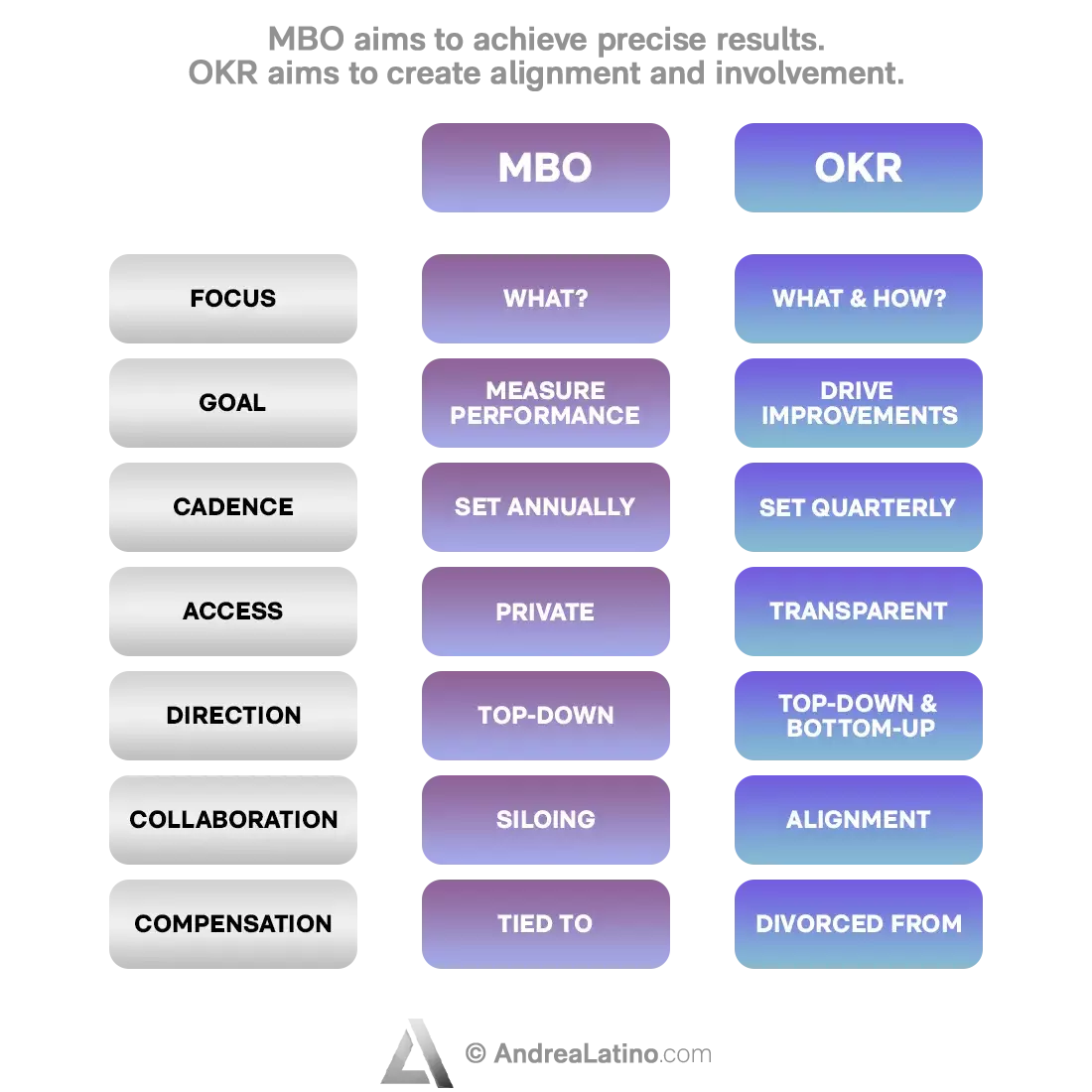
MBO is an evaluation method in which, given set goals, people are required to achieve precise results. It starts with outlining the strategic corporate objectives and then goes on to identify the operational goals of each business area. Here they are divided into action plans and, finally, individual goals. The individuals’ expectation is to receive a reward that repays them for the commitment and efforts made to achieve the result.
OKR, on the other hand, is a framework for creating alignment and engagement company-wide from top management down to the individual. The OKR method moves along two lines: objectives and key results. The goals are subjective, qualitative and, above all, ambitious. As such, they should motivate and stimulate the team. Key Results, instead, are quantitative, i.e., clear, defined, specific, and concrete metrics that measure progress toward the goal.
However, evaluation this time is not for punitive or reward purposes. In fact, the ultimate goal of the process is continuous improvement in order to achieve increasingly challenging business goals. When aligned, OKRs promote focus, simplicity, and short feedback loops. The result is that improvements are more easily spotted and implemented.
Application Fields

• E-commerce: When managing an online store, it is useful to apply the objectives-and-key-results methodology to develop your business in a clear and uniform manner. For example, if the goal is to increase the number of visitors within e-commerce, a necessary first step might be to initiate a content marketing or advertising campaign.
• Smart Working: OKRs applied to Smart Working make it possible to manage work from home. The definition of qualitative goals based on different levels (corporate, function, project and personal) is associated to measurable indicators in order to monitor their progress. This is a methodology that, together with core digital tools, enables companies to secure functional agile work.
• Improving corporate collaboration: The application of OKRs in a company presupposes the crucial involvement of the entire corporate team. In this way, every employee will feel involved in the realization of the company’s goals and thus equally responsible for the goals achieved.

Do you have a Operations & Human Resources challenge to tackle? Let’s face it. Together.
C-levels from these companies (AND MORE) relied on my expertise to overcome thEIR CHALLENGES IN THIS AREA. And You can, too.
Can I help you?
Industries
• OKR in the pharmaceutical industry
Engagedly is a next-generation performance management software that has drafted useful goals to train a team of healthcare professionals. They are the following: arrange interviews with at least 30 healthcare professionals each month for positions that include physicians, nurses and other hospital assistants; conduct training programs and seminars at universities to ensure that top talent does not slip through the cracks; offer training programs to improve staff skills.

• OKR in the energy industry
Ovo Energy, one of the UK’s leading energy companies, has grown exponentially through a series of maneuvers. For example, it has invested in green technology and explored new markets such as France, Italy, Spain and Australia. But there is also the fact that it has adopted Objectives and Key Results to track and improve development processes. Founder Stephen Fitzpatrick called the framework “a universal translator of progress”. Indeed, the ability to follow OKRs step by step and observe updates and their respective timelines ensures easy oversight of all teams and their progress.
• OKR in the service industry
Google has been using OKRs since 1999. The company’s growth is surely also due to the faithful adoption of this mode of organization, without which, perhaps, it would not have succeeded in becoming a world leader within Internet search engines. Google follows a strict ladder of goals and results. The set time to achieve OKRs is three months, and new OKRs are set every quarter. Each OKR is evaluated at the end of the three months, based on the method by which the key actions were performed, using a scale ranging from 0 to 1.0.
Business functions
• OKR in support of marketing
Following the introduction of a Brand Solutions department aimed at enhancing brand image so as to increase sales and ensure long-term customer loyalty, Zalando decided to use the methodology of working by objectives and results. The success and efficiency of OKRs convinced Zalando to extend OKRs throughout the whole company.
• OKR in support of HR
LinkedIn uses the OKR framework to manage its resources in a way to advance goal after goal. LinkedIn’s philosophy believes that, in order for an organization’s corporate vision and resulting missions to be fulfilled, the company itself must convey them to its leaders, not vice versa. Thus, once leaders are clear about the corporate purpose, they will be able to load the entire team on their shoulders. How? Using coaching, providing strategies, setting clear goals and measured results. The predetermined goals should be achieved in a limited time and function as incentives motivating the entire team.
• OKR in support of management
To organize the company’s management in a more functional way, Huawei changed its strategy in 2019 by abandoning KPIs (an ” after-the-fact” control) for OKRs (a “before-the-fact” plan). This makes it easier to provide employees with a clear understanding of the value of their aspirations. The executive management of the company has become much more functional.
Stay in wonderland
Let me show you how deep the rabbit hole goes.
Check out more of the Innovation Alphabet:

Gamification
Gamification
Gamification is actually adding a game-like element to make more fun and engaging something that’s not necessarily a game. It’s all about turning a task that might be boring or difficult into a more enjoyable and motivating activity. You can also earn points, badges, and rewards for completing certain actions or challenges. Are you ready to play?
Dive In
Business Intelligence
Business Intelligence
A smart business means efficiency: Business Intelligence represents the ability to collect up-to-date data, present it in easy-to-understand formats, and deliver it in a timely manner to employees. Making data-driven decision-making and management processes leads to competitive advantage, reduces inefficiencies, and improves productivity and service at all levels.
Dive In
Artificial Scarcity
Artificial Scarcity
We often tend to desire what we cannot have. Or what we are in danger of losing: Artificial Scarcity is a strategy that flaunts a limited number of items that do not correspond to actual availability. The goal is to stimulate the perception in consumers that the stock of items is about to run out and thus create a need based on the “fear of being cut off” or the intention to buy the item in order to resell it at a higher price.
Dive In
Subscription Model
Subscription Model
A subscription model is a business tool that generates revenue by charging customers a fee at regular intervals. The company provides products or services to subscribers on a subscription basis, usually monthly or annually. In this way, loyalty has become more important than acquiring new users.
Dive In
Holacracy & Flat Organization
Holacracy & Flat Organization
A “flat organization” breaks down the traditional hierarchy and removes its negative connotation, while “holacracy” is the business tool that facilitates its formation. Flat organizations place more emphasis on communication and collaboration, aspiring to a distributed decision-making process that gives each employee a voice. But this is a model that is difficult to implement.
Dive In
Mass Customization
Mass Customization
Mass customization is an initiative adopted by companies to embrace the increasingly diversified needs of customers. By offering customizable products and services, consumers feel engaged and can bring their creativity into play. Brands gain from this a boost in perceived value and the opportunity to fuel a positive word-of-mouth marketing.
Dive In
Coopetition
Coopetition
If you can’t beat them, join them. Coopetition is a business strategy that defines cooperative and competitive relationships between competing companies in the same young or high-growth market. The goal is to travel a stretch of road together to lower initial research and development costs. Once the desired results are achieved, the companies will return to being enemies as before.
Dive In
MVP
MVP
To the disappointment of all sports fans, this is not an article about Michael Jordan. In the language of business, MVP stands for Minimum Viable Product and indicates the version of a new product that has enough features to attract customers. In this way, a team can gather the most feedback with the least effort, improve the prototype, and validate its sale.
Dive In
Agile
Agile
Agile is an approach to software development designed to respond to change. Teams quickly analyze the context in which they operate, identify uncertainties faced, and figure out how to adapt to always move forward. Interaction between individuals comes before processes and tools; collaboration with the customer is more important than negotiating contracts.
Dive In
Bounded Rationality
Bounded Rationality
The best solutions always come to mind when it is too late. This is because human beings tend to make decisions on the basis of satisfaction rather than optimization. Bounded Rationality means that we are unable to think clearly and linearly, we proceed by trial and error and forget all the possible variables that affect the process. But we are also flawed.
Dive In