SWOT Analysis
Innovation Alphabet
SWOT Analysis
in a nutshell
Strengths, weaknesses, opportunities, and threats. These are the variables of the SWOT analysis, a simple but effective tool for facilitating a rapid synthesis of internal factors, capable of determining a condition of competitive advantage – and external factors – allowing the implementation of measures to exploit potential positive effects and mitigate the negative ones.

Application Fields
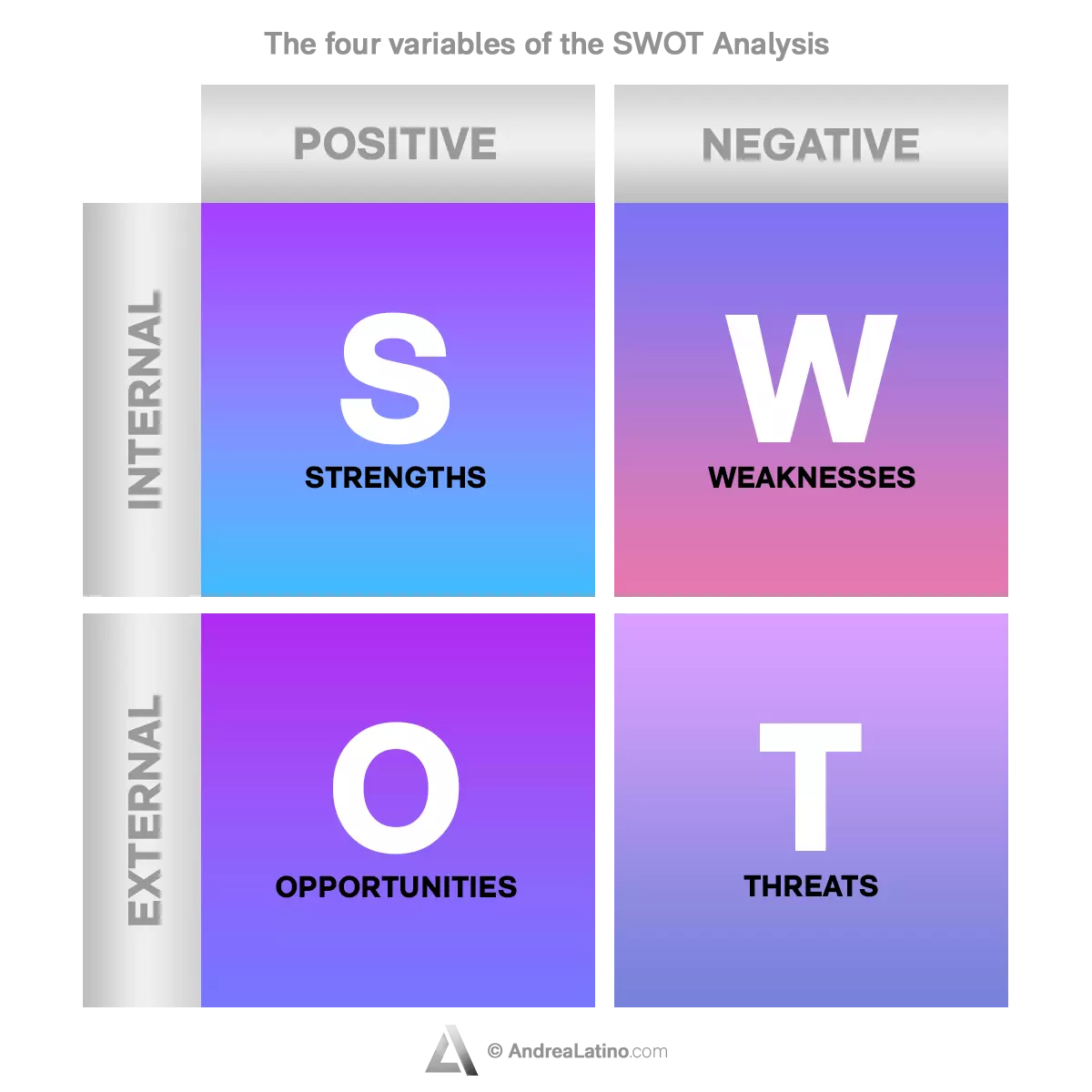
• Strategy: By leveraging its SWOT, any company can create a strategic plan to meet its goals and adapt to changing market conditions.
• Personal Branding: In order to strategically manage one’s professional image and to improve one’s working career, it is definitely useful to start with a SWOT. By intervening on internal factors and keeping external factors under control, it is possible to achieve greater awareness of one’s skills, be they hard or soft.
• Digital Communication: Starting with a better understanding of a brand’s vulnerabilities and the areas in which it is superior, a company can initiate a communication strategy based on its strengths, but without sweeping weaknesses under the rug – they are nothing but opportunities to be exploited.
Industries
• SWOT Analysis in the FMCG industry
In 2015, Value Line, an independent U.S. investment research firm, conducted a SWOT on “The Coca-Cola Company”, noting among its strengths its worldwide reputation, extensive distribution network, and opportunities in emerging markets. However, contrary to what one might think, Coca-Cola also has weaknesses, and possible threats from outside: we are talking, for example, about the growing public interest in “healthy” drinks sold by competitors.
• SWOT Analysis in the retail industry
Bed, Bath & Beyond is an American retail chain with more than 1,000 physical stores. In 2017, Value Line again conducted a survey to perform a SWOT Analysis on the household goods company. The result was that despite having strong Brand Awareness (given its presence on the market for more than 40 years) it was strongly threatened by Amazon, which operates in the same sector.
• SWOT Analysis in the entertainment industry
The name Mattel evokes childhood memories related to our favorite toys. Founded in 1945, the company was the subject of a SWOT in 2017. A strong market presence was noted, even though threats included Hasbro, its major competitor. Weaknesses included merchandising opportunities.



Do you have a Marketing & Sales challenge to tackle? Let’s face it. Together.
C-levels from these companies (AND MORE) relied on my expertise to overcome thEIR CHALLENGES IN THIS AREA. And You can, too.
Can I help you?

Business Functions
• SWOT Analysis in support of influencer marketing
In 2019, the launch of the #DearSouthAfrica campaign enabled Zara to engage 60 micro-influencers, earning the engagement of 8 million people. An emblematic example of capitalizing on an opportunity detected by a SWOT Analysis. The initiative started with the opening of the clothing giant’s online store in South Africa and turned out to be a successful campaign.
• SWOT Analysis in support of customer journey
Even large companies like Amazon resort to SWOT in order to be able to improve their business. Amazon certainly needs no introduction, and it is a fact that one of its great assets is data. Starting with a massive amount of computer information about their customers’ buying methods and habits, Amazon has been able to leverage it to deepen its loyalty work.
• SWOT Analysis in support of strategy
Cape Breton Island is a Canadian island of about 10km2 overlooking the Atlantic Ocean. In 2018, a SWOT Analysis led to an evaluation of the corporate strategy of the island’s transportation company, Transport Action Atlantic. The study identified strategic priorities and shortcomings for which the company should have come prepared.
Stay in wonderland
Let me show you how deep the rabbit hole goes.
Check out more of the Innovation Alphabet:

Gamification
Gamification
Gamification is actually adding a game-like element to make more fun and engaging something that’s not necessarily a game. It’s all about turning a task that might be boring or difficult into a more enjoyable and motivating activity. You can also earn points, badges, and rewards for completing certain actions or challenges. Are you ready to play?
Dive In
Business Intelligence
Business Intelligence
A smart business means efficiency: Business Intelligence represents the ability to collect up-to-date data, present it in easy-to-understand formats, and deliver it in a timely manner to employees. Making data-driven decision-making and management processes leads to competitive advantage, reduces inefficiencies, and improves productivity and service at all levels.
Dive In
Artificial Scarcity
Artificial Scarcity
We often tend to desire what we cannot have. Or what we are in danger of losing: Artificial Scarcity is a strategy that flaunts a limited number of items that do not correspond to actual availability. The goal is to stimulate the perception in consumers that the stock of items is about to run out and thus create a need based on the “fear of being cut off” or the intention to buy the item in order to resell it at a higher price.
Dive In
Subscription Model
Subscription Model
A subscription model is a business tool that generates revenue by charging customers a fee at regular intervals. The company provides products or services to subscribers on a subscription basis, usually monthly or annually. In this way, loyalty has become more important than acquiring new users.
Dive In
Holacracy & Flat Organization
Holacracy & Flat Organization
A “flat organization” breaks down the traditional hierarchy and removes its negative connotation, while “holacracy” is the business tool that facilitates its formation. Flat organizations place more emphasis on communication and collaboration, aspiring to a distributed decision-making process that gives each employee a voice. But this is a model that is difficult to implement.
Dive In
Mass Customization
Mass Customization
Mass customization is an initiative adopted by companies to embrace the increasingly diversified needs of customers. By offering customizable products and services, consumers feel engaged and can bring their creativity into play. Brands gain from this a boost in perceived value and the opportunity to fuel a positive word-of-mouth marketing.
Dive In
Coopetition
Coopetition
If you can’t beat them, join them. Coopetition is a business strategy that defines cooperative and competitive relationships between competing companies in the same young or high-growth market. The goal is to travel a stretch of road together to lower initial research and development costs. Once the desired results are achieved, the companies will return to being enemies as before.
Dive In
MVP
MVP
To the disappointment of all sports fans, this is not an article about Michael Jordan. In the language of business, MVP stands for Minimum Viable Product and indicates the version of a new product that has enough features to attract customers. In this way, a team can gather the most feedback with the least effort, improve the prototype, and validate its sale.
Dive In
Agile
Agile
Agile is an approach to software development designed to respond to change. Teams quickly analyze the context in which they operate, identify uncertainties faced, and figure out how to adapt to always move forward. Interaction between individuals comes before processes and tools; collaboration with the customer is more important than negotiating contracts.
Dive In
Bounded Rationality
Bounded Rationality
The best solutions always come to mind when it is too late. This is because human beings tend to make decisions on the basis of satisfaction rather than optimization. Bounded Rationality means that we are unable to think clearly and linearly, we proceed by trial and error and forget all the possible variables that affect the process. But we are also flawed.
Dive In