Innovation Alphabet
Augmented Reality
In a nutshell
Augmented Reality is an ever-evolving technology that overlays multimedia information on top of our common sensory horizon to gain a deeper understanding of our surroundings. No, it does not allow you to step out of the Matrix dream simulation, nor can it be accessed by swallowing a red pill. But neither is it the disturbing experience of the Playtest episode of Black Mirror. It is much more than that.

Application Fields
• Augmented SatNav: In addition to the normal functions of a classic SatNav, Augmented Reality uses the smartphone’s camera to provide additional real-time information such as the location of gas stations, speed cameras, or places of interest. Where is the big news? All of this is displayed directly on the windshield of the car. Indeed, some cars that take advantage of this technology provide the driver with a totally unobstructed front view. How? Making the hood of the vehicle transparent and thus the part of the road normally covered visible.

• Hawk-eye. It is a precise tool used in sports that takes advantage of Augmented Reality to assist the match director in his or her decisions. For example, in tennis it is used to check whether the ball ended up off the court or not. In soccer, on the other hand, it is used to award a goal of difficult evaluation or let the game continue. This system works through cameras installed in strategic points of the field. It allows the trajectory of the ball to be reconstructed in order to determine the correct conclusion of the action.

• Museums: Augmented Reality could stimulate a new attractiveness in cultural venues such as museums, especially in the most bitter despisers of the visual arts. Simply pointing your cell phone at the work on display will open you up to new immersive and engaging experiences such as meeting the artist of a painting, seeing a worn fresco reconstructed, or admiring an extinct animal come back to life by pawing around us.
Industries
• Augmented Reality in the pharmaceutical industry
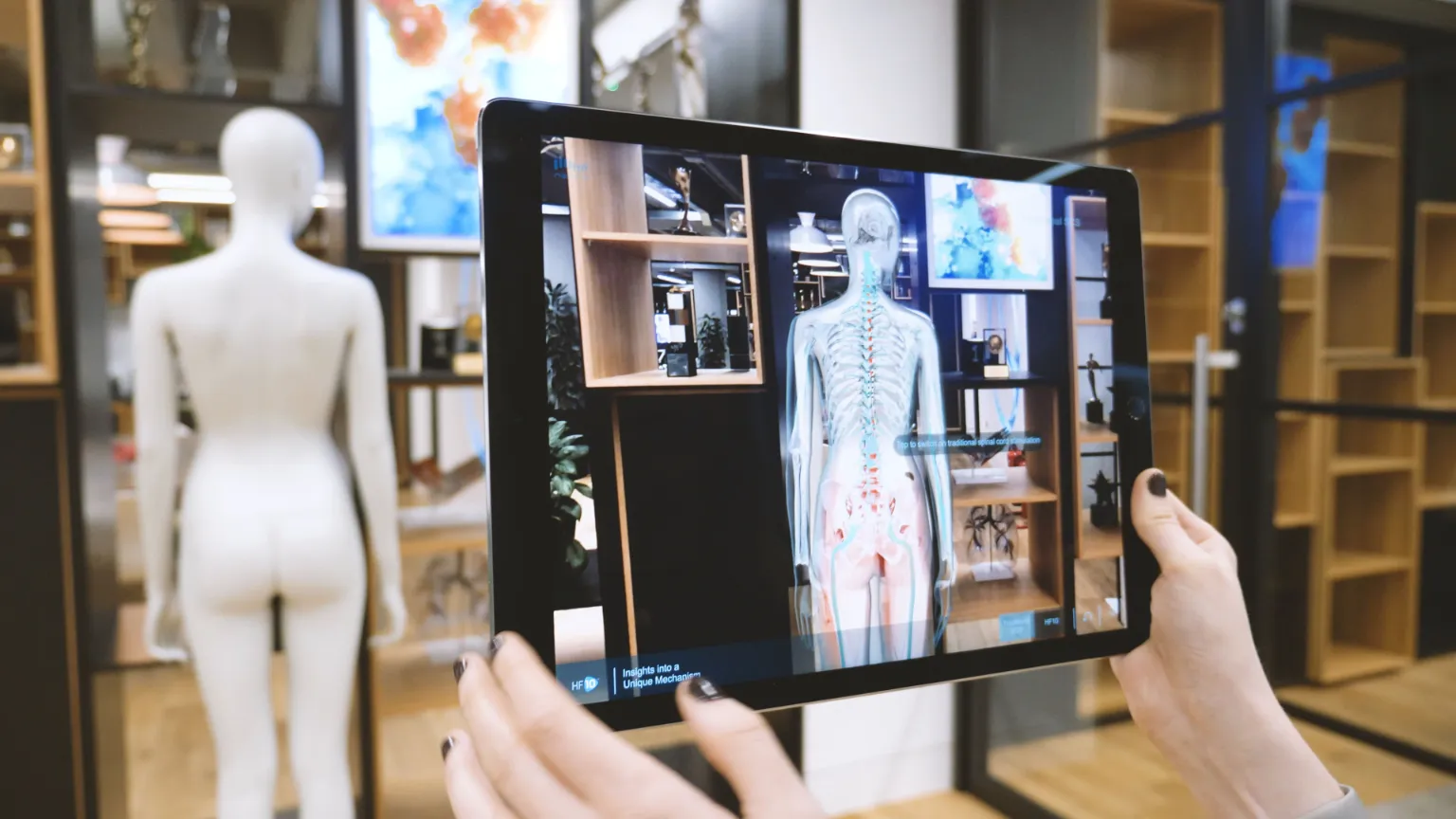
No more endless and unclear buzzwords. With the introduction of Augmented Reality in the pharmaceutical industry, it is possible to download an application from the smartphone that allows the patient to observe in 3D the functioning of the drug in front of his or her eyes. The software, in fact, recognizes medicine packages and informs the patient in an effective and engaging way.
• Augmented Reality in the energy industry
The study on the possible relationship between Augmented Reality and the power industry conducted by EPRI (Electric Power Research Institute) is aimed at finding a solution to improve efficiency in the construction, maintenance, and repair of large infrastructures. Examples of future forms of AR applied to the power industry include contact lenses (aimed at replacing head-mounted equipment) and smart clothing integrated with Augmented Reality devices. But important human factors and safety issues are at stake. So, a deep understanding of how technology will safely and effectively influence worker concerns will be critical first.
• Augmented Reality in the service industry
DBG Management & Consulting, an Italian strategic consulting firm, has designed an Augmented Reality tool first presented at ITF Slovakia Tour 2020 (the Tourism Fair of the Visegrád Economic Area). It is a device that contains interactive and multilingual signage that can be used by blind and deaf people. Also, it has content designed for children and with the possibility of accessing information on demand. It is currently under exclusive concession in Slovakia, Poland, Hungary, and the Czech Republic.




Do you have a Strategy & Innovation challenge to tackle? Let’s face it. Together.
C-levels from these companies (AND MORE) relied on my expertise to overcome thEIR CHALLENGES IN THIS AREA. And you can, too.
Can I help you?

Business Functions
• Augmented Reality in support of marketing
Even the most common of pre-technological toys has not resisted the influence of Augmented Reality: the Danish company Lego has improved an application aimed at children – called “Lego Hidden Side” – that turns the phone or tablet into an interactive tool for ghost hunting. Scanning the colored bricks in each building will unleash a hidden world of supernatural adventures.

• Augmented Reality in support of HR
The human resources sector has integrated many of its activities with Augmented Reality capabilities. Augmented Reality can actually be applied in support of HR, for example, for staff training by simulating a work environment. This is what companies such as General Electric or Papa Murphy requested from the technology innovation specialist Blippar. Since onboarding is a critical phase – during which everything regarding the company, policies, procedures, and culture must be explained to the selected candidate – the use of immersive technologies allows new employees to take a virtual tour of the office while listening to everything they need for their first day on the job.
• Augmented Reality in support of facility management
The Facility Management Team in charge of powering the Burj Khalifa skyscraper in Dubai – now the tallest in the world (about 830 meters) – uses AR to remotely monitor the 400 electrical loads present (including the 57 elevators), thus reducing operating costs by up to 30 percent. In addition, the existing sensors release real-time data useful for monitoring conditions of use, thus optimizing routine maintenance work. A record not only of height, but also of efficiency.
Stay in wonderland
Let me show you how deep the rabbit hole goes.
Check out more of the Innovation Alphabet:

Gamification
Gamification
Gamification is actually adding a game-like element to make more fun and engaging something that’s not necessarily a game. It’s all about turning a task that might be boring or difficult into a more enjoyable and motivating activity. You can also earn points, badges, and rewards for completing certain actions or challenges. Are you ready to play?
Dive In
Business Intelligence
Business Intelligence
A smart business means efficiency: Business Intelligence represents the ability to collect up-to-date data, present it in easy-to-understand formats, and deliver it in a timely manner to employees. Making data-driven decision-making and management processes leads to competitive advantage, reduces inefficiencies, and improves productivity and service at all levels.
Dive In
Artificial Scarcity
Artificial Scarcity
We often tend to desire what we cannot have. Or what we are in danger of losing: Artificial Scarcity is a strategy that flaunts a limited number of items that do not correspond to actual availability. The goal is to stimulate the perception in consumers that the stock of items is about to run out and thus create a need based on the “fear of being cut off” or the intention to buy the item in order to resell it at a higher price.
Dive In
Subscription Model
Subscription Model
A subscription model is a business tool that generates revenue by charging customers a fee at regular intervals. The company provides products or services to subscribers on a subscription basis, usually monthly or annually. In this way, loyalty has become more important than acquiring new users.
Dive In
Holacracy & Flat Organization
Holacracy & Flat Organization
A “flat organization” breaks down the traditional hierarchy and removes its negative connotation, while “holacracy” is the business tool that facilitates its formation. Flat organizations place more emphasis on communication and collaboration, aspiring to a distributed decision-making process that gives each employee a voice. But this is a model that is difficult to implement.
Dive In
Mass Customization
Mass Customization
Mass customization is an initiative adopted by companies to embrace the increasingly diversified needs of customers. By offering customizable products and services, consumers feel engaged and can bring their creativity into play. Brands gain from this a boost in perceived value and the opportunity to fuel a positive word-of-mouth marketing.
Dive In
Coopetition
Coopetition
If you can’t beat them, join them. Coopetition is a business strategy that defines cooperative and competitive relationships between competing companies in the same young or high-growth market. The goal is to travel a stretch of road together to lower initial research and development costs. Once the desired results are achieved, the companies will return to being enemies as before.
Dive In
MVP
MVP
To the disappointment of all sports fans, this is not an article about Michael Jordan. In the language of business, MVP stands for Minimum Viable Product and indicates the version of a new product that has enough features to attract customers. In this way, a team can gather the most feedback with the least effort, improve the prototype, and validate its sale.
Dive In
Agile
Agile
Agile is an approach to software development designed to respond to change. Teams quickly analyze the context in which they operate, identify uncertainties faced, and figure out how to adapt to always move forward. Interaction between individuals comes before processes and tools; collaboration with the customer is more important than negotiating contracts.
Dive In
Bounded Rationality
Bounded Rationality
The best solutions always come to mind when it is too late. This is because human beings tend to make decisions on the basis of satisfaction rather than optimization. Bounded Rationality means that we are unable to think clearly and linearly, we proceed by trial and error and forget all the possible variables that affect the process. But we are also flawed.
Dive In